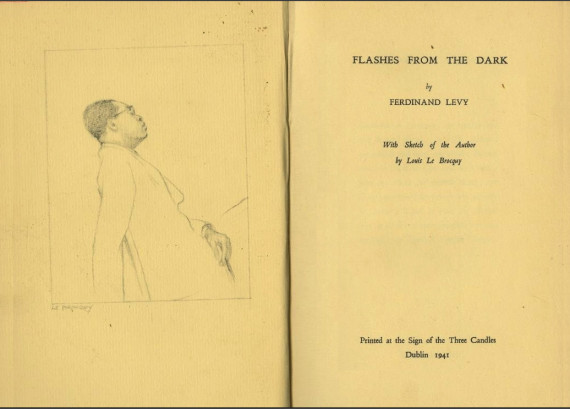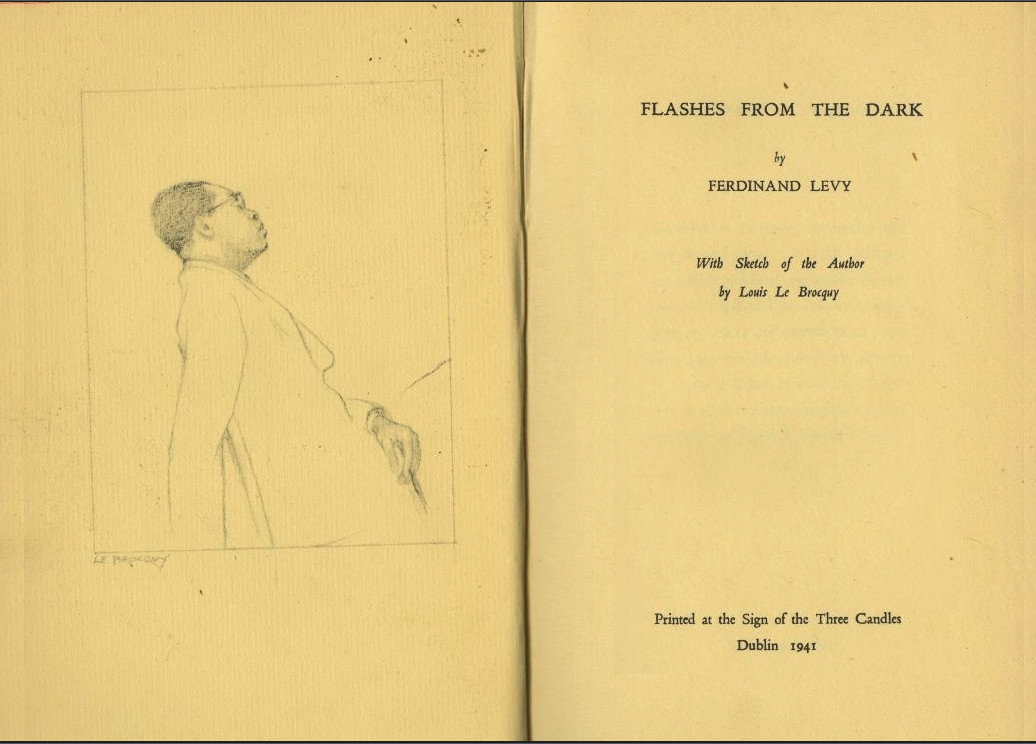
Born in Jamaica in 1904, Ferdinand Levy lived for almost two decades in Dublin while studying medicine at Trinity College Dublin. He is possibly the first black poet published in Ireland. His only book of poems, Flashes from the Dark, was published in Dublin by Colm O’Lochlainn’s Three Candles Press in 1941.
Levy eventually became a Medical Officer of Health for the Parish of St. James, Montego Bay in Jamaica where he died in 1972. He lived in New York in the late 1920s, bringing something of the Harlem Renaissance to Lower Baggot Street.
Senator John Harold Douglas, at whose wedding Levy served as a groom, described his friend in an obituary in The Irish Times as “a well-known personality” in 1930s Dublin, “patron of the arts, and a poet of no small merit”. Columnists leave impressions of a “trim, immaculate figure with… long, thin cigarette holder”, an ‘inveterate first nighter… quite a character in cosmopolitan Dublin’.
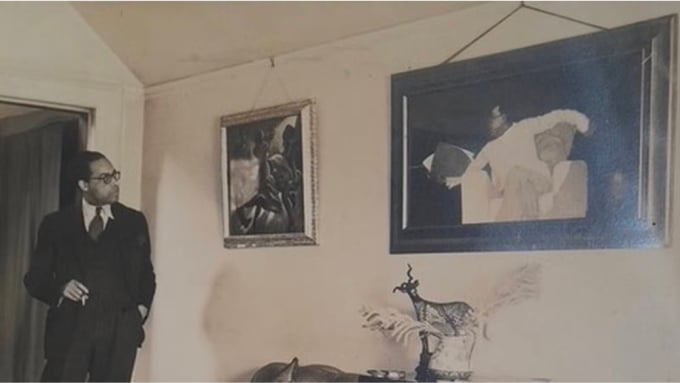
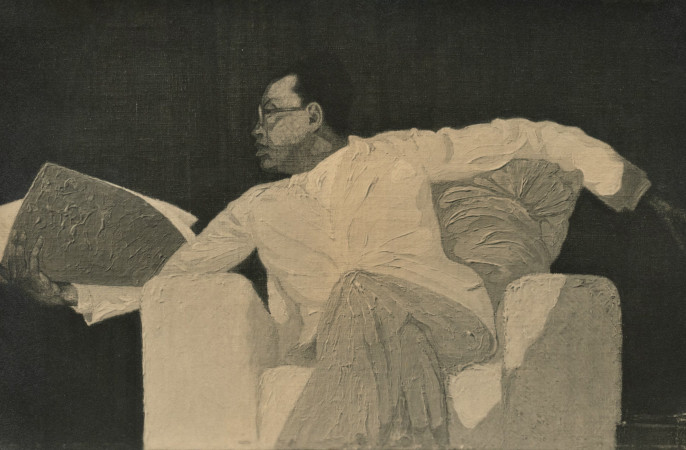
Levy had many passions besides poetry: he co-founded the Dublin Gramophone Society, and he was an art collector of major Irish painters, including Mainie Jellett, Paul Henry, and Louis le Brocquy.
The latter painted Levy’s portrait in 1939:
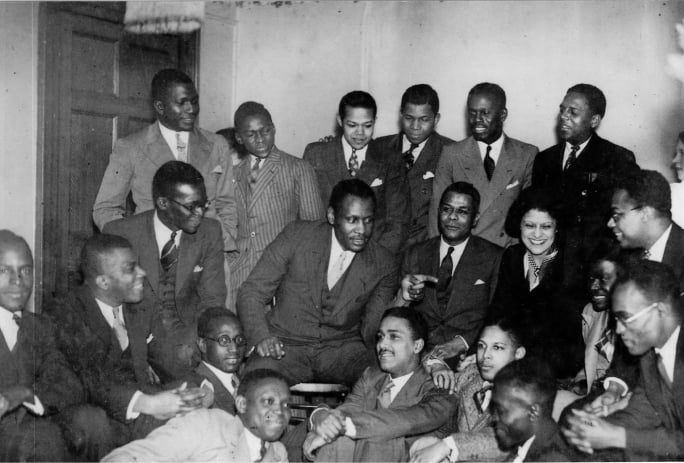
During the 1930s, Levy was President of the Association for Students of African Descent in Dublin. Members included future Nigerian statesman and jurist, Jaja Wachuku, and New York ENT specialist and McArdle prize-winning surgeon, the Trinidadian Errol A. Thompson.
This photograph, taken in Levy’s flat on Baggot Street, shows ASAD members entertaining the singer and activist Paul Robeson during a 1935 visit to Dublin.
The last stronghold
Of all black men
Is now devoured
By the whites.
The pretext now
Is not as when
The French and British
Robbed
Our rights […]
Awake
O bleeding Africa!
Avenge
This gaping Roman wound!
Rouse your sons
From Cape to Daka’
Our sprawl out there
Levy’s combination of cosmopolitanism and anti-colonial struggle led him to critique Irish nationalism. In letters to Lyon, he draws out what “the black race have … to learn from the Irish”:
‘They really do enjoy themselves at a dance. The Tango, the Paul Jones, the Old Fashion Waltzes and what have you. Complete abandonment. I find the Irish a race just waking up, as from a long sleep; and gradually coming to realise that they are free from the harsh master’s yoke (England). They are now running rampant with nationalism: Ireland for the Irish! Buy Irish goods! Our Irish spirit! And a lot of other such tripe… Whether or not this will be successful is doubtful, not in this age when the entire world [yearns] for unity. If the movement is making any headway, I have yet to be convinced.’
Levy’s combination of cosmopolitanism and anti-colonial struggle led him to critique Irish nationalism. In letters to Lyon, he draws out what “the black race have … to learn from the Irish”:
I saw her walking
Down O’Connell Street—
Lord, Lord!—
Down O’Connell Street.
The wind was sharp;
She dared not creep—
Lord, Lord!—
Down O’Connell Street.
All dressed in green
From head to feet—
Lord, Lord!—
Down O’Connell Street.
I saw her turn
With a graceful sweep—
Lord, Lord!—
Down O’Connell Street.
The smile she smiled
Was indiscreet—
Lord, Lord!—
Down O’Connell Street.
Would God I knew
The doll who smiled
But dared not speak—
Lord, Lord!—
Down O’Connell Street.
I’d make her know
That tropic love is sweet.
Lord, No!—
Not down O’Connell Street
In November 1941, Levy read his poems at a candlelight masque in the Dublin Painter’s Gallery, alongside several poets including Stephen Spender and British cultural attache, John Betjeman. A correspondent stated that Levy read his poems better than any other reader at the occasion. While his reading included poems not published in Flashes from the Dark, Levy appears to have published no new poetry after 1943’s Runa Press Quarto poem, ‘Harlem Depression’.
Despite favourable reviews from luminaries such as Austin Clarke and encouragement from AE (George Russell), Levy has failed to garner more than a footnote in Irish literary history.